


Suspension Repair
Replacement of leaf springs, suspension bushings, and stabilizer components. Service and repair for DAF, MAN, BPW, and other commercial vehicle brands.

The Poltava branch of the Ukrainian Spring Center specializes in the repair of suspension systems, axles, trailers, engines, and chassis components for all types of vehicles—from passenger cars to commercial trucks and specialized equipment. With over ten years of experience, we offer a fully stocked spare parts warehouse and an in-house engineering department.
 2K+ Vehicles Repaired
 100+ Engineering Solutions
 Serving Poltava Since 2022
 300+ Regular Clients
URC Service Station in Poltava provides maintenance and repair services for the full range of vehicles—from passenger cars to long-haul trucks and heavy equipment used on construction sites.
Replacement of leaf springs, suspension bushings, and stabilizer components. Service and repair for DAF, MAN, BPW, and other commercial vehicle brands.
Oil, filter, and brake pad replacement.
Computer diagnostics, system monitoring, ECAS control unit parameterization, and ECU removal and installation.
Replacement of kingpins and thrust bearings, elimination of axial play.
Repair of suspension, brake systems, kingpins, and air suspension systems. Service for SCHMITZ and other manufacturers.
Replacement of cylinder liners, pistons, bearings, and piston rings.
Replacement of guide pins, dust boots, repair kits, and restoration of caliper mounting surfaces.
Comprehensive maintenance and repair services for passenger vehicles.
Repair of hydraulic cylinders and mounting components, replacement of pins, bushings, and hydraulic fluid.
Complete and spot painting of vehicles, axles, frames, and metal components.
Replacement of axle end components, thread restoration, and repair and reinforcement of axle beams.
Restoration of steering knuckle mounting surfaces and bushing of worn mounting holes.
Restoration of bearing seats, replacement of wheel bearings, seals, and repair kits.

Your truck's suspension absorbs the weight of the cargo, impacts from rough roads, and the forces generated during braking every day. Ignoring the first warning signs can turn a minor repair into the replacement of an entire suspension assembly.
The suspension is the truck assembly that quietly takes the load until the last moment. While the steering works and the engine starts, drivers rarely think about leaf springs, silent blocks or stabilizers.
Here are the signs worth noticing before the suspension fails on the road.
If a truck or trailer starts leaning or floating during lane changes, the cause is often the anti-roll bar or worn spring bushings.
A metallic knock over bumps usually points to worn bushings, spring pins or mounts. Squeaking often means dry joints or worn stabilizer bushings.
If tyres wear on one side or diagonally, the real cause is often incorrect geometry caused by a bent spring, worn spindle or faulty kingpin.
A visible body tilt is a warning sign. Most often it means a cracked or broken leaf spring, and the vehicle should not go on a trip in that condition.
Vibration that increases during braking is a reason to check hubs and bearings.
For trailers and semi-trailers, the issue is often the air suspension: air spring, shock absorber or level sensor.
Suspension and brakes work together. If the vehicle pulls aside while braking, check not only the brakes but also kingpins and leaf springs.
Ignoring these symptoms accelerates tyre and chassis wear, increases the risk of breakdown on the road and can lead to loss of control.
URC service station in Poltava diagnoses and repairs truck and trailer suspension: leaf springs, silent blocks, stabilizers, pins and spindles for DAF, MAN, BPW, SAF, Schmitz and other commercial vehicles.
Do not delay diagnostics — replacing one bushing early is much cheaper than repairing a breakdown during a route.

Trailer downtime means missed deliveries, financial penalties, and damage to your company's reputation. Learn which components wear out the fastest and why scheduled preventive maintenance is far more cost-effective than unexpected emergency repairs.
For a transport company, trailer downtime is more than a repair bill. It means a missed route, delivery penalties and a client who may call a competitor tomorrow.
Here is what wears out fastest and how scheduled maintenance saves more than it seems.
Air suspension on Schmitz, Krone, Wielton and other semi-trailers works under harsh conditions: full loads, rough roads and daily mileage.
Trailers have a separate pneumatic brake system. Air leaks, worn pads or drums, and faulty ABS/EBS sensors quickly affect safety and tyre life.
Play in the kingpin or a worn support bearing causes the trailer to wander behind the tractor at speed. This unit should be checked instrumentally during every scheduled service.
Trailers with tail lifts have extra risk points: hydraulic cylinders, lift bushings and mounting points. Small play can quickly become a hydraulic leak.
Replacing one bushing or air spring on schedule is cheaper than road recovery, a new tyre set caused by axle misalignment, a missed delivery and repairs to related components.
URC service station in Poltava provides a full repair cycle for trailers and semi-trailers: suspension, brakes, pneumatics, kingpins, axles, hubs, machining and welding.
If you are planning trailer service or diagnostics, book it in advance before the repair becomes an emergency on the road.
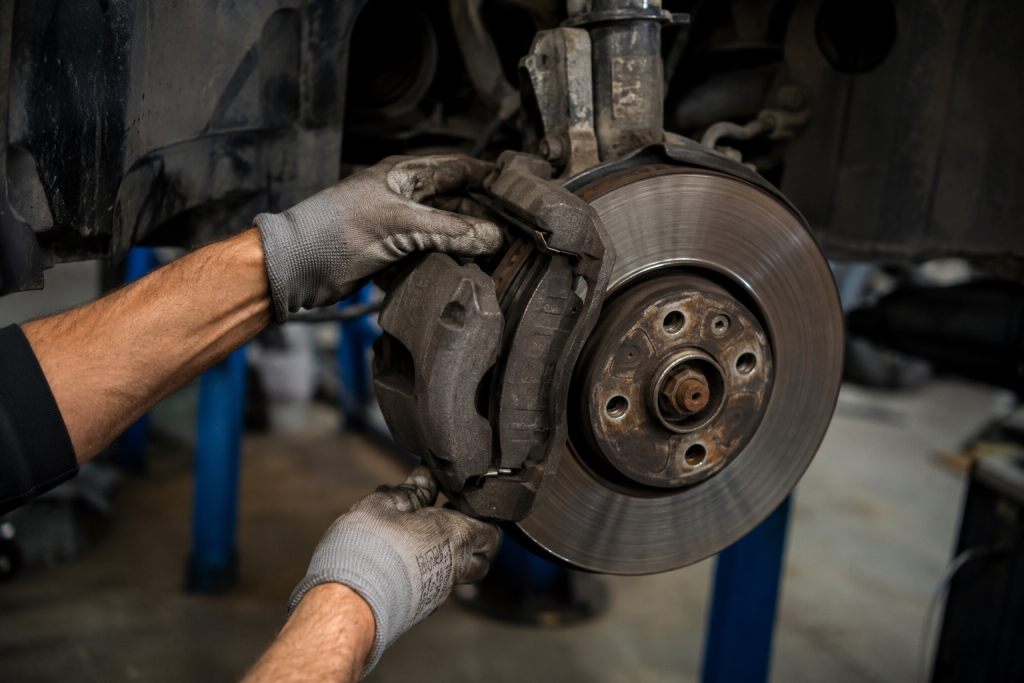
The braking system is one of the truck’s components where you should never cut corners. On heavy-duty vehicles, it is closely connected to the pneumatic system: air pressure activates the brake chambers, spring brake actuators and air suspension. If the air pressure drops or even one component of the circuit becomes worn, the braking distance increases, as does the risk of an emergency situation on the road. In this article, we take a detailed look at the most common services requested by truck, bus and trailer owners in Poltava and the surrounding region: replacement of brake drums, linings and spring brake actuators, as well as diagnostics and repair of pneumatic systems.
Truck Brake System Repair: Where Diagnostics Begin
Before replacing any component, the specialists at URC Service Station in Poltava carry out a comprehensive inspection of the braking system:
You should visit a service station if you notice an increased braking distance, vibration or a knocking sound when braking, air whistling or hissing from under the cab or around the axles, uneven wheel wear, or a brake system warning light on the dashboard.
Brake Drum Replacement in Poltava
A brake drum operates in constant contact with the brake linings and gradually wears out. Grooves, ovality and cracks caused by overheating may appear. Driving with a worn brake drum is dangerous: the contact area with the lining decreases, braking distance increases, and in the worst case, the drum can crack during hard braking.
Signs that brake drums need to be replaced:
At URC Service Station in Poltava, brake drum replacement is performed together with an inspection of related components — hubs, bearings and brake linings — so that the wheel does not have to be removed again shortly afterward. We work with brake drums for MAN, DAF, Mercedes, Scania, Volvo, Iveco and other vehicles.
Brake Lining (Brake Pad) Replacement in Poltava
Brake linings (brake pads) are wear components that require scheduled replacement. On trucks operating on routes with frequent stops — in cities, on construction sites or during deliveries — wear occurs faster than on long-haul vehicles.
When should brake linings be replaced?
An important point: brake linings should always be replaced as a complete set on an axle rather than individually. Otherwise, braking force may be distributed unevenly between the wheels on the same axle, causing the vehicle to pull to one side when braking. We keep brake linings from leading manufacturers in stock — up to 10,000 different spare parts are available, allowing selection and replacement to be carried out without long waits for parts to be ordered.
Spring Brake Actuator Replacement
A spring brake actuator is a component responsible for both service and parking braking on truck axles. If the actuator fails, the parking brake may not hold the vehicle on a slope. Conversely, the wheels may remain partially locked even after the parking brake is released.
Typical spring brake actuator faults include:
Because of their complex design, which combines compressed air pressure with a heavily loaded mechanical spring, spring brake actuator replacement and disassembly should be entrusted to a service station with specialized equipment and experience working with heavy-duty vehicles. Disassembly without the proper equipment is dangerous because of the compressed spring inside the housing. At URC Service Station in Poltava, these jobs are performed in compliance with safety requirements, followed by a check of the operating pressure after installation.
Truck Pneumatic System: How It Works and Why It Is Not Just About Brakes
A truck’s pneumatic system is responsible for more than just braking. It may also operate the cab and chassis air suspension, clutch actuators on some models, power windows and pneumatic distributors. At the heart of the system is the compressor, which pumps air into the reservoirs, along with a network of valves, control valves and lines that distribute pressure between the circuits.
The main components our specialists most frequently work with include:
Pneumatic System Repair: Common Problems
The most common pneumatic system issues reported to URC Service Station in Poltava include:
Pneumatic system diagnostics are performed comprehensively: the entire circuit from the compressor to the actuators is inspected rather than focusing only on the component where the symptom appears. This helps identify the root cause rather than simply eliminating the symptom.
Air Suspension Bellows Replacement
Air suspension bellows (air springs) provide a smooth ride on trucks, buses and trailers equipped with air suspension. A worn or damaged air spring loses its airtightness, causing the body to sag on one side or at the rear.
Signs of a worn air spring include:
Air spring replacement is carried out together with an inspection of the mounting points, ride-height sensors (if the suspension has electronic control) and related pneumatic components.
Pneumatic Equipment Repair: Compressors, Valves and Air Reservoirs
In addition to replacing individual components, we repair and service key pneumatic system components:
Timely pneumatic equipment maintenance helps prevent sudden brake or suspension failure on the road — a case where preventive maintenance is far less expensive than repairing a breakdown after the vehicle has failed on a highway.
Why Choose URC Service Station in Poltava
Planning diagnostics or brake system repair for a truck, bus or trailer in Poltava? Submit a request or call our specialists — we will select the necessary parts and arrange a convenient appointment time.
Frequently Asked Questions
How often should brake linings be replaced on a truck?
The service life depends on operating conditions. On routes with frequent stops, such as urban routes and construction sites, wear occurs faster than on long-haul routes. A general guideline is replacement when the remaining friction material is 2–3 mm thick; the exact replacement interval is determined during diagnostics.
Can a spring brake actuator be repaired yourself?
No. Disassembling a spring brake actuator is dangerous because of the compressed spring inside the housing. This work should be performed by specialists using appropriate tools and with experience working on heavy-duty vehicles.
Why does the pneumatic system take longer to build up pressure?
The most common causes are a worn compressor, a clogged air dryer, or a leak in connections and valves. The exact cause can be determined through comprehensive circuit diagnostics.
What are the signs that an air spring needs to be replaced?
Cracks in the rubber bellows, the vehicle body sagging on one side, air hissing around the suspension while driving, and frequent compressor activation to compensate for an air leak.
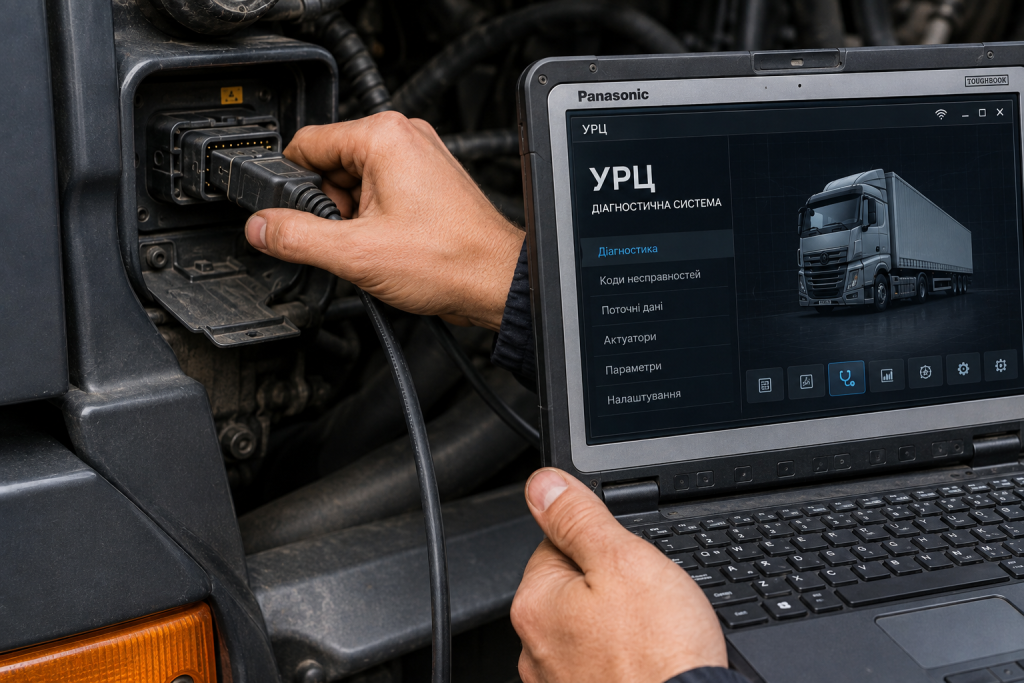
A significant share of downtime involving trucks, buses, and trailers is caused not by the engine or suspension, but by electrical problems. A short circuit in the wiring, an ECAS sensor failure, or an ECU error can stop a vehicle just as effectively as a broken axle — but the cause is much harder to find without the right diagnostic equipment. URC Poltava Service Station provides computer diagnostics and electrical system repairs for commercial vehicles of all major brands: MAN, Scania, Mercedes, Volvo, Iveco, Renault, MAZ, KRAZ, and KAMAZ.
Electrical faults rarely look the same twice, but there are symptoms that almost always indicate that diagnostics are needed:
● a “check” light is illuminated on the dashboard or new error codes appear;
● the truck is difficult to start or stalls for no apparent reason;
● the air suspension (ECAS) does not maintain the correct ride height, rises or lowers on its own;
● lights, brake lights, or the trailer’s turn signals do not work or start flashing;
● communication between the tractor unit and trailer is intermittently lost over the CAN bus;
● an unexpected electrical fault appears after another component has been repaired.
If the vehicle is on a trip and the fault occurs on a road in the Poltava region, it is best to record the error code immediately, if the onboard computer provides access to it. This can significantly reduce diagnostic time at the service station.
● Computer diagnostics. Reading and interpreting fault codes from the engine, braking system, suspension, and transmission.
● ECAS diagnostics and parameterization. Checking ride-height sensors and air suspension valves, as well as configuring parameters after component replacement.
● ECU removal, installation, and testing. Diagnostics of electronic control units for the engine and body electronics.
● Electrical wiring repair. Locating open circuits, short circuits, and corroded contacts; replacing damaged sections of wiring harnesses on tractor units and trailers.
● Trailer and semi-trailer electrical systems. Repair of connectors, lighting, and ABS/EBS sensors on SCHMITZ trailers and other manufacturers’ equipment.
● Sensor and relay diagnostics. Testing pressure, temperature, and position sensors, as well as power relays and fuses.
● Spare parts in stock. Our own spare parts warehouse means that common sensors, relays, and wiring components do not have to be ordered and waited for weeks — unlike situations where a part has to be specially ordered for a specific repair.
● Comprehensive approach. A truck’s electrical system is closely connected with its pneumatic and braking systems. That is why diagnostics are carried out by a team that already works with the suspension, axles, and brakes of the same vehicle, rather than by a separate contractor.
● Experience with commercial vehicles. We work with electrical systems of MAN, Scania, Mercedes, Volvo, Iveco, Renault, as well as domestic MAZ, KRAZ, and KAMAZ vehicles.
● Realistic repair times. URC customers note that our technicians provide a realistic repair timeframe from the start and stick to it — which is critically important for carriers who count every day of vehicle downtime.
How long does truck electrical diagnostics take?
Computer diagnostics usually takes from 30 minutes to several hours, depending on whether the task is simply to read fault codes or to locate an intermittent wiring connection that only appears under load.
Can an ECU be repaired instead of replaced with a new one?
In many cases, yes. Component-level diagnostics can identify and replace the specific faulty component instead of replacing the entire control unit. The final decision is made after diagnostics at the service station.
What should I do if an electrical fault occurs during a trip?
Record the conditions under which the problem occurs (while driving, at idle, or after stopping) and contact the service station in advance. This will help the technicians prepare the necessary spare parts before the vehicle arrives.
I was on a long-haul trip when a serious mechanical issue occurred. The team at URC didn't just replace a single part—they identified the root cause of the problem and fixed it properly. What impressed me most was that the required spare part was already in stock, so I didn't have to wait several days. From now on, whenever I need repairs, this is my first choice.
I've been bringing my vehicles here for service for quite some time. What I appreciate most is that the team provides realistic completion times and sticks to them. For anyone working in freight transportation, that's extremely important. I've never experienced a situation where they promised one deadline but the vehicle ended up sitting for another week waiting for parts.
I've visited many service centers, but this one truly stands out for its extensive spare parts inventory. When I arrived, I expected to wait for a hard-to-find part to be delivered. Instead, they had it in stock. My vehicle was repaired the same day, and I was able to get back to work without delay.
What I like is that they don't just fix the obvious problem and send you on your way. They inspect everything related to the fault and explain what should be repaired now to help prevent a breakdown on the road later. I much prefer this approach to constantly coming back for small repairs.
I originally brought only my tractor unit here for repairs, but now I also trust them with my passenger car. They work efficiently, most spare parts are available in stock, and the customer service is excellent. Knowing my vehicle will be ready on the promised day makes it much easier to plan my work.
During harvest season, every hour matters. One day my combine harvester broke down in the middle of a field, and I thought we'd lose at least half a day. I called URC, and a technician came directly to the site, quickly diagnosed the problem, and inspected the machine. The issue was fixed on the spot, so there was no need to transport the equipment to the service center.


